The game
The Gazillion game, explained
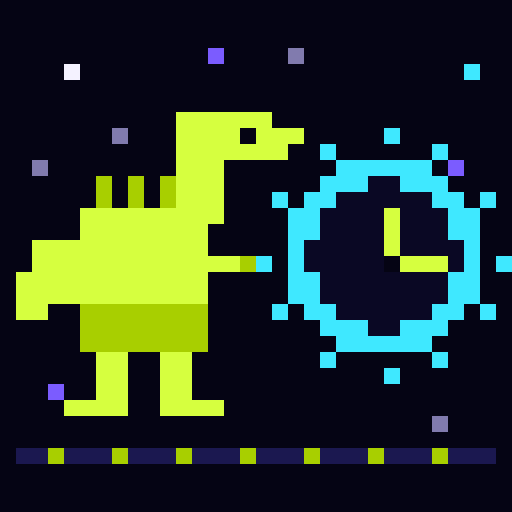
A daily history game where the year is the puzzle. Five moments, one timeline from the Big Bang to today, and a pixel dinosaur who travels back through time to celebrate how close you got.
What the Gazillion game is
Gazillion is a free browser game about the size of history. Each day you get five historical moments, and for each one you place a range of years on a timeline that stretches from the Big Bang to this morning. The truth has to fall inside your bracket. The tighter the bracket, the higher the score. The Gazillion game runs in your browser with no download and no account.
That is the whole loop, and it is deliberately small: read, drag, lock, learn. What makes it a game rather than a quiz is the timeline itself. It is logarithmic, so a moment from 2007 and a moment from 200 million years ago can share the same screen without one of them being a smudge at the edge. Every round is also a small history lesson, because the answer comes with a fact you did not know.
Gazillion is an original game, built for this site. It is not a clone, not a port and not affiliated with any other game or company. You can read more on the about page.
How one day works
Every day has a puzzle number and five moments. The puzzle changes at midnight in your local time, so the reset respects where you actually live rather than a server somewhere else. You get one attempt at the daily; after that, the day's result is yours to keep, share and compare.
A round lasts at most 40 seconds. A perfect day is 5,000 points, and the game tracks your total, your streak, your best and a passport of the eras you have reached. Finish the day and you get a spoiler-free emoji row that says how each moment went without giving anything away to a friend who has not played yet.
Miss a day? Nothing is lost forever: the archive lets you replay published puzzles without touching your streak. A new season is a fresh run of dailies, and the days already in the archive stay playable.
Why the game is free
Gazillion is free, and it is free in the boring, literal way: no subscription, no paywall, no ads, no premium tiers, no “watch this to continue”. There is no account to create and nothing to download. Open the page and play.
It stays free because it is cheap to run: a small static site, self-hosted fonts, two small analytics tags that count visits, and no ad network. Your progress is stored in your own browser rather than in a database we have to pay for. The privacy policy is short because there is genuinely very little to disclose. If that sounds like a business model that makes no sense, you are right — it is a game, not a funnel.
Why it is called Gazillion
“Gazillion” is one of those cheerful fake numbers people use when a real figure would undersell the point: a gazillion stars, a gazillion reasons, one in a gazillion. It has no fixed value, which makes it the right mascot for a timeline that contains everything from the first stars to yesterday's news.
It also gives the game its best moment. Score a perfect 5,000 and the game stamps the screen with ONE IN A GAZILLION. The word is the joke, the scale and the trophy all at once. If you want the full history of the word, zeros included (or rather not included), read what is a gazillion?
Who it is for
Gazillion is for people who like knowing when things happened, and for people who do not yet realise they do. If you play a daily word game on your commute, this is the same habit pointed at a different kind of knowledge: chronology rather than vocabulary. If you are a history teacher, the daily is a two-minute warm-up that produces a real discussion about scale and periodisation.
You do not need to be a history expert. The difficulty of the moments is mixed — obvious ones sit next to specialists' ones — and the scoring rewards a well-aimed guess, not encyclopaedic recall. The game never shames a miss; the dinosaur looks disappointed for about half a second and then the fact appears. If you are weighing it against other daily games, our games like Wordle guide is an honest map of the genre.
Play today's five
There is no better explanation than one round. The first moment takes a few seconds to read, the timeline explains itself the moment you drag it, and the reveal tells you how close you were. If you want the mechanics in more detail first, the how to play page covers scoring, modes and strategy.
Then come back tomorrow. The daily changes at local midnight, your streak is waiting, and the dinosaur has eight eras of scenery to travel through. Play the Gazillion game — it is free, it is quick, and it will quietly change how you think about the year 1450.
Frequently asked questions
Is Gazillion free to play?
Yes. Every mode is free, there are no ads, no in-app purchases and no account. The game is funded by being cheap to run, not by monetising players.
Do I need to download an app?
No. Gazillion runs in your browser on desktop and mobile. It is built to work well on a phone with a thumb on the timeline.
How is Gazillion different from a history quiz?
You do not type a year: you trap it inside a range on a logarithmic timeline from the Big Bang to today, and you are scored on how tight and accurate that range is.
Is Gazillion a Wordle clone?
No. It shares the daily-puzzle format with other daily games but the puzzle is a historical timeline, not a word. Gazillion is an original game and is not affiliated with Wordle or The New York Times.
Can I play Gazillion on my phone?
Yes, that is the primary target. Touch targets are at least 44 pixels, the timeline supports drag and pinch, and the layout works from 390 pixels wide upwards.
What happens to my progress if I clear my browser?
Your progress lives in your browser's local storage, so clearing site data resets it. There is no server copy and no account to recover it from.
Gazillion is an original daily history game inspired by the daily-puzzle genre. It is not affiliated with any other game, site or company.
Historical dates are checked against standard references; moments the game marks with “c.” are approximate by nature.